
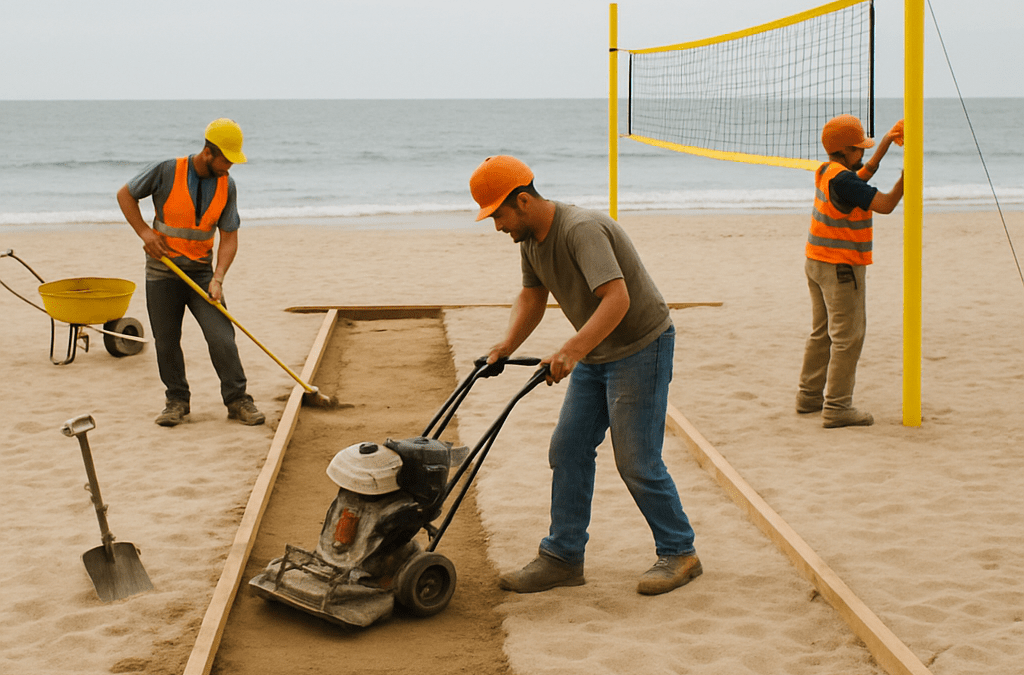
Before you start building, it’s crucial to understand the beach volleyball court specifications and volleyball court specs required for safe, enjoyable play. These specifications ensure that the court not only meets recreational standards but also aligns with official guidelines for competitive play. Adhering to these guidelines is essential, as it enhances the credibility and usability of the court for both casual and professional players. This guide to Designing the Perfect Beach Volleyball Court keeps the original intent while clarifying key volleyball court dimensions and measurements.
Court Dimensions
The official size of a beach volleyball court is 16 meters long and 8 meters wide (beach volleyball court dimensions). When converted to feet, this translates to approximately 52.5 feet by 26.25 feet—commonly referenced as the volleyball court dimensions in feet or volleyball court size in feet. In yards, that’s about 17.5 by 8.75 yards, which answers how many yards is a volleyball court for the beach format. The court is divided into two equal halves by a net. The net height is set at 2.43 meters (approximately 7 feet 11 5/8 inches) for men and 2.24 meters (approximately 7 feet 4 1/8 inches) for women.

These details reflect the regulation volleyball court size for outdoor beach play. If you’re wondering how big is a beach volleyball court or how long is a volleyball court, the length of volleyball court in this format is 16 meters (52.5 feet). In short, the size of volleyball court for beach matches is standardized globally to maintain consistency.
Surrounding Space
In addition to the court itself, you must allocate space around the court for player safety and comfort. A free zone of at least 3 meters (approximately 9.8 feet) should surround the court on all sides, providing ample room for players to move freely. For outdoor volleyball court size planning, include this buffer to handle dynamic play safely on any beach volley court.
Sand Depth and Quality
The sand used in a beach volleyball court must be of high quality to ensure player safety and comfort. The sand should be free of rocks, shells, and other debris that could cause injury. A depth of at least 40 centimeters (approximately 16 inches) is recommended to provide a soft landing surface. For a standard field-of-play plus the 3-meter free zone, plan roughly 120–130 cubic meters of sand (about 180–210 tons), which addresses how much sand for a beach volleyball court. These sand volleyball court specifications—clean sand, consistent depth, and even distribution—directly affect performance and safety. If you’re asking how big is sand volleyball court, it matches the beach volleyball court dimensions above.
Steps to Building a Beach Volleyball Court

Now that you understand the specifications, it’s time to dive into the construction process. Wondering how to build a beach volleyball court or how to build a sand volleyball court? The outline below shows how to build a volleyball court—essentially how are volleyball courts made—from site prep to net installation. Each step is designed to ensure the final product is durable, safe, and enjoyable for all users.
Choosing the Right Location
Select a location that is level and well-drained to prevent water accumulation. The area should be free from overhead obstructions like trees or power lines that could interfere with play. Ideally, the site should have a natural windbreak to reduce the impact of wind on gameplay. Consider the orientation of the court as well, positioning it to minimize sun glare during peak playing times.
Preparing the Site
Begin by marking the court dimensions and the surrounding free zone. Remove any grass, rocks, or debris from the area. It’s essential to ensure the ground is even before adding sand. You may need to level the ground or add a drainage system if the site is prone to waterlogging. Proper drainage protects the integrity of the court and supports consistent beach volleyball court specifications by reducing erosion and sand compaction.
Installing the Net System
Install sturdy poles to support the net at the correct height. The poles should be placed outside the court boundaries to avoid interference with play. Ensure that the net is taut and meets the official height specifications for the type of play you are accommodating. Consider using adjustable pole systems that allow for quick height adjustments, catering to different age groups and levels of play.
Adding Sand
Transport high-quality sand to the site and distribute it evenly across the court area. Use a compactor to ensure the sand is packed tightly, providing a stable playing surface. Regular maintenance, such as raking and leveling, will keep the court in optimal condition. Additionally, periodic sand replacement may be necessary to maintain its quality and depth over time. These tasks are core to how to make a sand volleyball court that performs well season after season.
Enhancing the Beach Volleyball Experience

A well-designed beach volleyball court can be more than just a place to play; it can be a hub for community engagement and enjoyment. Here are some ideas to enhance the experience for players and spectators alike, transforming your court into a vibrant community asset.
Lighting and Amenities
If your court will be used after dark, consider installing lighting that provides adequate visibility without causing glare. Additionally, amenities such as seating areas, shade structures, and water stations can enhance the comfort and convenience of players and spectators. Thoughtfully designed amenities not only improve the user experience but also encourage longer visits and repeat participation.
Safety and Accessibility
Ensure the court is accessible to all users, including those with mobility challenges. This may involve creating pathways or installing ramps. Safety should also be a priority, with clear signage and regular maintenance checks to prevent accidents. Providing first aid stations and ensuring easy access for emergency services can further enhance the safety of your facility.
Hosting Tournaments and Events
A beach volleyball court can serve as a venue for tournaments and community events. Hosting events can increase community engagement and promote the facility as a local attraction. Consider working with local sports organizations to host competitions or recreational leagues. Offering training clinics and workshops can also be a great way to engage the community and promote the sport.
Quick Specs and FAQs
- Beach volleyball court dimensions (regulation volleyball court size): 16 m x 8 m (52.5 ft x 26.25 ft), about 17.5 yd x 8.75 yd.
- Volleyball court dimensions and measurements (beach): Net height 2.43 m for men, 2.24 m for women.
- What are the measurements for a volleyball court (beach)? See the dimensions and net heights above.
- How big is a volleyball court? For beach play, it’s 16 m by 8 m; indoor courts differ.
- How big is a beach volleyball court? Same as above: 16 m x 8 m (volleyball court dimensions in feet: 52.5 ft x 26.25 ft).
- How long is a volleyball court? The length of volleyball court (beach) is 16 m (52.5 ft).
- Sand volleyball court size and sand volleyball court dimensions: identical to beach specs; plan a 3 m free zone.
- Outdoor volleyball court size tip: include a free zone of at least 3 m (9.8 ft) on all sides.
- How much sand for a beach volleyball court? Approximately 120–130 m³ (about 180–210 tons) for the court plus free zone at 40 cm depth.
- Specifications of volleyball court (beach): clean, well-draining sand; even grade; sturdy, adjustable net system; clear boundary lines (also called a beach volley court in some regions).
Conclusion
Designing the perfect beach volleyball court involves more than just meeting size requirements. By considering location, construction, and user experience, you can create a facility that enhances your community or property development. Whether for school programs, community recreation, or residential appeal, a well-planned beach volleyball court is an investment in health, wellness, and social interaction.
By following these guidelines, you can ensure your court is not only functional but also a source of pride and enjoyment for players and spectators. Embrace the challenge and create a space that will serve your community or development for years to come. The effort put into thoughtful design and construction will pay dividends in fostering community spirit and promoting an active lifestyle.