
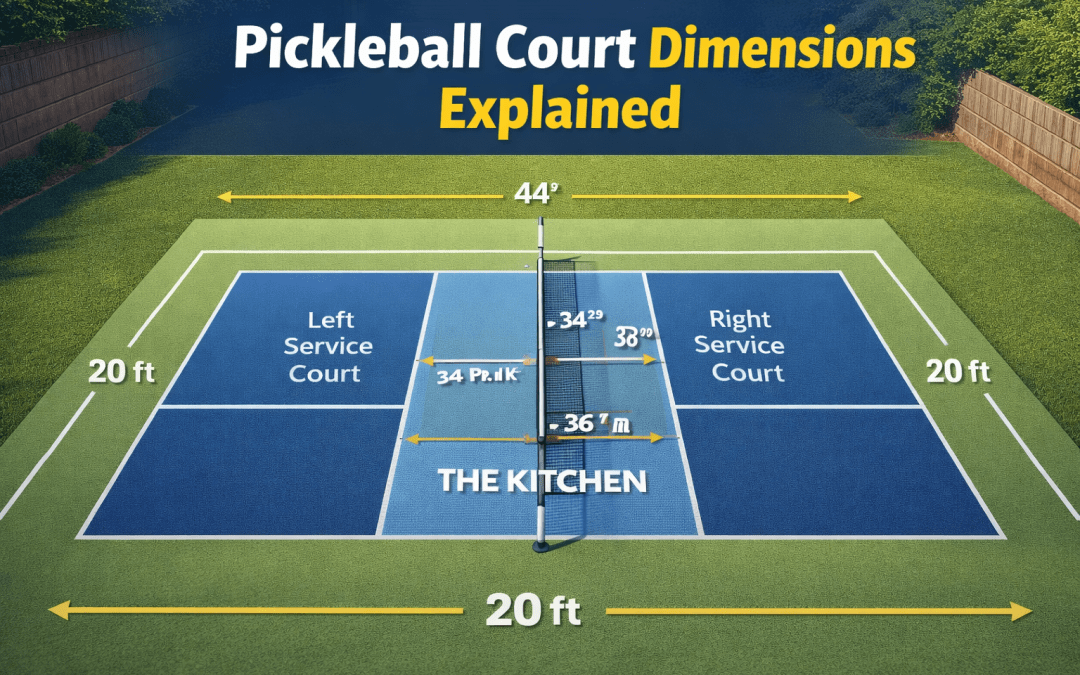
Thinking about setting up your own pickleball court? Your first question is probably, ‘Do I even have enough room?’ The good news is that you most likely do, and figuring it out is simpler than you might imagine. Forget complicated blueprints. Pickleball court dimensions come down to just three key measurements that define the entire playing area. A regulation court is surprisingly compact—it’s the exact same size as a doubles badminton court, which is why it fits so well in many driveways. This guide will give you the clarity to decide if a home court is a feasible project for you.
The Magic Numbers: Your Court’s Overall Footprint
So, just how big is a standard pickleball court dimension? The official playing lines form a rectangle that is 44 feet long and 20 feet wide. To help you picture it, imagine the space needed for a one-car garage or a large recreational vehicle. This compact layout is a key reason the sport can fit so easily in many backyards and driveways, making it incredibly accessible.
Of course, you’ll need more room than just the lines to play safely. Think about chasing a wide shot or backing up to return a high, arching lob. For this reason, the recommended total playing area is 64 feet long by 34 feet wide. This buffer provides the minimum space needed for a home court where you can move freely without worrying about obstacles.
The game itself happens within the 44′ x 20′ lines, but the action requires that larger safety zone. The first and most important feature that splits this area is the net.
Splitting the Court: Understanding the Net and Centerline
Stretching across the center of the 44-foot court, the net officially stands 36 inches high at the posts and sags to 34 inches in the middle. This two-inch drop is a subtle but important feature. To picture it, the 34-inch center height is roughly waist-high on a shorter adult or about the same as a typical barstool. This accessible barrier encourages long, exciting rallies over brute-force smashes.
Beyond the net, the only other line dividing the space is a simple centerline. This line runs from the back of the court (the baseline) up toward the area near the net. Its one and only job is to create the two rectangular boxes on each side that players must serve into—a left service court and a right service court.
The most strategic area of the court, however—and the one that gives pickleball its unique character—lies in the space between these serving boxes and the net.

Decoding ‘The Kitchen’: The Most Important 7 Feet in Pickleball Court Dimensions
That unique space is officially called the Non-Volley Zone (NVZ), but you’ll almost always hear it referred to by its popular nickname: “the Kitchen.” Its defining rule is simple: you are not allowed to stand inside the Kitchen and volley the ball—that is, hit it out of the air before it bounces on your side of the court.
This zone exists to keep the game strategic and fun. Think of it as a “no-smash zone” that extends from the net. This rule prevents players from simply camping out at the net and slamming every shot, encouraging longer, more interesting rallies instead of just contests of power. The Kitchen rules are what make the game so distinct from tennis.
So, how big is it? The line marking this zone’s edge is set exactly 7 feet back from the net, creating a 14-foot-wide restricted area across the court’s center. Knowing this 7-foot measurement is essential for avoiding faults and playing the game correctly.
Where to Stand: Defining the Left and Right Pickleball Service Courts
Once you look past the Kitchen, the rest of the pickleball court’s layout is straightforward. These pickleball court dimensions divide the large rectangular area at the back is split right down the middle by the centerline, creating two equal boxes for serving.
Each of these boxes is a Service Court, measuring 10 feet wide by 15 feet long. The line at the very back of the court, which marks the outer boundary, is called the Baseline. When it’s your turn to serve, you must stand behind this baseline.
These pickleball court dimensions do more than just tell you where to stand. They also define the target for the serve. The rules require you to hit the ball diagonally across the net into the opposite service court. This simple back-and-forth pattern ensures a fair and predictable start to every single point.

How Pickleball Stacks Up to Tennis and Badminton Courts
A helpful secret is that a regulation pickleball court is the exact same size as a doubles badminton court. Both share an identical 44-foot by 20-foot footprint, which makes converting a badminton court to pickleball incredibly simple. If you find badminton lines at a local gym or park, you’ve already found a perfect space to play.
The comparison to a tennis court is just as useful. A tennis court is so much larger that you can fit four complete pickleball courts inside its boundaries. This 4-to-1 ratio is why you often see a single tennis court converted for multiple, simultaneous pickleball games.
This powerful flexibility is a key reason for the sport’s explosive growth. You don’t need a dedicated, brand-new court to start playing; with a portable net and some tape, you can easily adapt existing spaces. Knowing these pickleball court dimensions isn’t just theory—it’s your first step toward creating a court almost anywhere.
Your 3-Step Plan to Lay Out a Home Court
You have the three key numbers you need (the 44′ x 20′ overall court, a 7-foot Kitchen, and a 34″ net) to create your own DIY pickleball court.
Here’s your simple 3-step plan to get playing:
- Measure Your Space: Find a 44′ x 20′ flat area.
- Mark Your Lines: Use chalk or painter’s tape for the baseline, sidelines, and Kitchen lines.
- Set Up a Net: Buy a portable pickleball net, which is easy to assemble.
Don’t worry about getting the lines perfectly straight. The goal isn’t a professional stadium; it’s creating a space for fun and connection. That chalk outline is more than a court—it’s an invitation to play.
Sports Surface can help you build your dream pickleball court.