
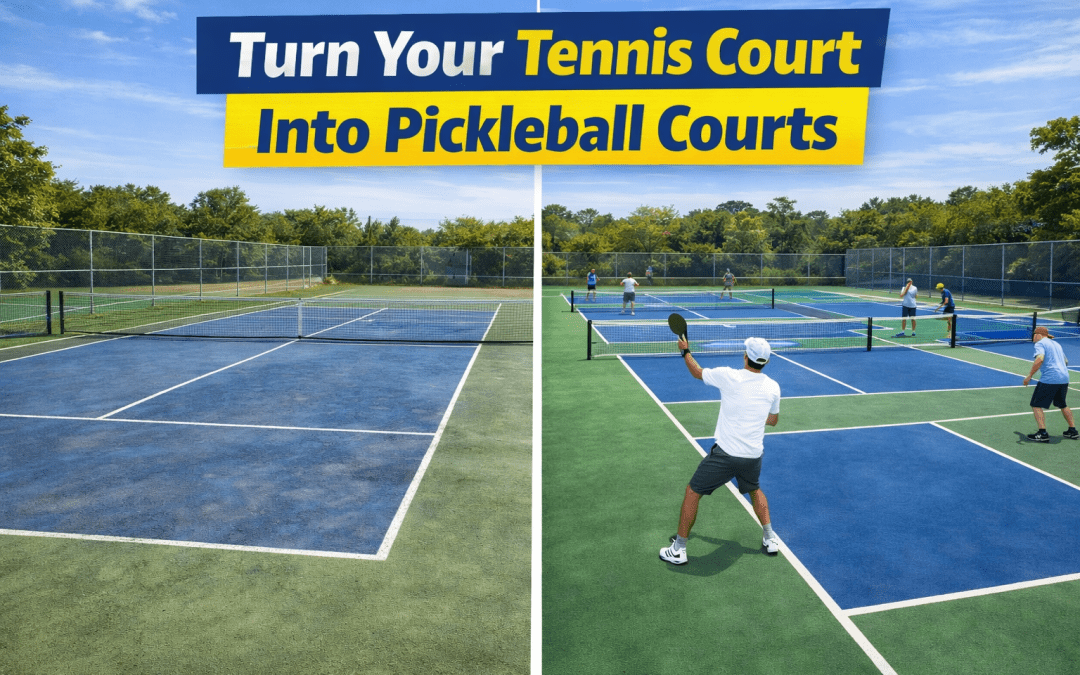
So, you’re ready to join the pickleball revolution by planning a tennis court to pickleball conversion. Before dreaming of dinks and drop shots, you’re likely asking the number one question: What level of investment does this take? The answer ranges from a simple DIY setup to a complete professional overhaul — and it all starts with the easiest way to try pickleball.
For those just wanting to test the sport, a DIY conversion is the obvious first step. You can be playing in an afternoon with minimal tools and setup. This temporary approach involves outlining a pickleball court with specialty tape or chalk and setting up a portable, regulation-height net.
A typical court conversion kit usually includes:
Temporary line markers (tape or chalk)
A portable pickleball net
Measuring tape
These temporary lines are perfect for testing the waters, but they don’t last long. Most peel after a few games or bad weather, making this a trial solution rather than a permanent upgrade.
One Court, Two Games: How to Fit Pickleball Courts on Your Tennis Court
Since pickleball courts are significantly smaller than tennis courts, you have multiple layout options — including how many pickleball courts fit on one tennis court. Most facilities choose between a two-court or four-court setup. A two-court layout offers more space around the edges, while a four-court configuration maximizes playing capacity, making it ideal for clubs and communities.
To avoid confusion, shared-use courts rely on high-contrast pickleball court line colors. Tennis lines remain white, while pickleball lines are painted in softer shades like blue or yellow. This makes each sport’s boundaries instantly recognizable while keeping the surface usable for both.
Choosing your layout is a balance between space, comfort, and capacity. A two-court setup feels more open and is preferred for competitive play, while four courts are better for high-volume recreational use. This decision also affects how complex the painting process will be.

The Pro “Blended Court” Finish: In a Tennis Court to Pickleball Conversion
For a durable, long-term solution without the hassle of re-taping, professional line striping is the best option. If your tennis court surface is already in good condition, this upgrade delivers lasting results and a clean, professional appearance.
However, this option only works if your court is smooth, level, and free from serious cracks. Painting lines over damaged pavement is like repainting a cracked wall — the surface issues quickly return and ruin the finish. A contractor will inspect your court first to confirm it’s suitable.
Professional striping includes power washing for adhesion, precision layout measurements, masking, and the application of specialized acrylic court paint. This paint is weather-resistant, textured for traction, and designed to match the rest of your playing surface.
The Full Overhaul: Why You Might Need to Resurface Your Court
Sometimes, a court needs more than new lines. If the surface has visible cracks, slick areas, or puddles after rain, the underlying pavement is failing and you’re likely facing pickleball court surface damage that requires professional repair. (Get professional repair from Sport Surface – Top Rated Sports Court Construction Company). These low spots — known as “bird baths” — mean the court is no longer level, and repainting alone won’t fix the problem.
Resurfacing addresses these issues at the structural level. The process involves crack repair, surface grinding, leveling compounds, and multiple layers of acrylic resurfacer to restore a smooth, uniform plane. Only after this foundation work are color coats and lines applied.
While resurfacing requires a larger investment, it dramatically improves safety, ball bounce consistency, and long-term durability. It also extends the usable life of the court for years rather than seasons.
Beyond the Surface: 3 Other Factor Into Your Budget
Once the court surface is handled, several additional upgrades can affect play quality and usability:
Net System: Pickleball nets are lower than tennis nets. Portable nets work for flexibility, while permanent conversion systems offer better stability and performance.
Lighting Adjustments: Tennis lighting often creates shadows on smaller pickleball courts. Re-aiming or upgrading fixtures improves visibility for evening play.
Fencing Modifications: Pickleballs travel farther than expected and often clear tennis fences. Interior fencing or curtains help contain stray balls.
Planning for these elements ensures your court feels professional, comfortable, and highly playable.
So, Which Conversion is Right for You? A Final Summary
You now have three clear paths:
A temporary DIY setup for casual play, professional line painting on a good surface, or full resurfacing for courts showing structural wear.
Your first step isn’t calling a contractor — it’s walking outside and assessing whether your court needs simple line striping or full resurfacing. Look closely at your court’s surface. The cracks, texture, and drainage will tell you exactly which conversion path makes the most sense.
Choosing the right tennis court to pickleball conversion approach depends entirely on your court’s condition, usage goals, and long-term expectations.