
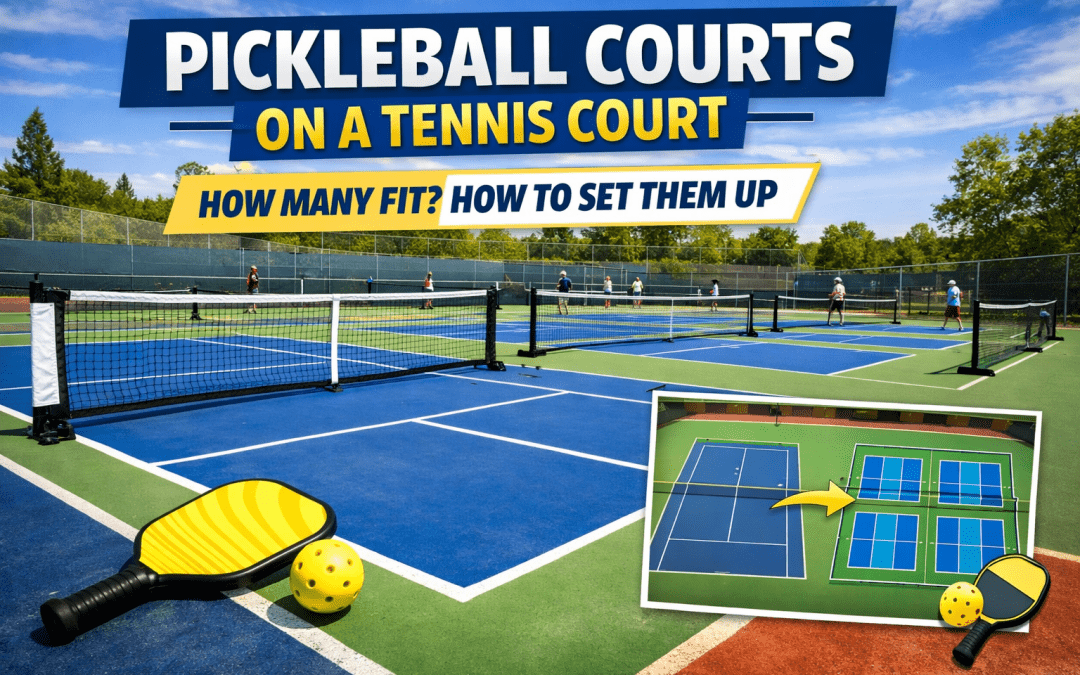
Pickleball courts on a tennis court are becoming a common sight. Have you walked past a local tennis court recently and noticed some strange, new lines painted inside the old ones? You’re not just seeing things. Those markings are for pickleball, which the Sports & Fitness Industry Association reports has been the fastest-growing sport in America for several years running.
With so many people eager to play, finding a dedicated place can be a challenge. This is why communities are getting creative by adding pickleball lines to a tennis court. It’s an ideal solution because a standard tennis court offers more than enough space to be easily adapted for the much smaller pickleball court.
Here, we’ll explain how one, two, or even four pickleball courts can fit on a tennis court and cover the simple steps for setting them up. You’ll see how a space for four players can be transformed to host up to sixteen.
Pickleball Court vs. Tennis Court: Why Size Makes a Big Difference
A pickleball court is significantly smaller than a tennis court. Measuring just 44 feet long by 20 feet wide, its total area is roughly the same as the four service boxes on a tennis court combined. This compact size immediately makes the game more approachable, as it requires less sprinting and focuses more on quick, reactive shots over a smaller distance.
Beyond its smaller footprint, a pickleball court has one unique feature that defines the game: a seven-foot zone on each side of the net called the Non-Volley Zone, or more famously, “the kitchen.” The most important rule here is that you cannot hit the ball out of the air (a volley) while your feet are inside this area. This prevents players from simply smashing the ball at the net and encourages the strategic, dinking rallies that make pickleball famous.
Together, the compact dimensions of pickleball court and the kitchen rule are what make the game so accessible. The smaller court makes it easier for players of all ages and fitness levels to participate, while the kitchen ensures that strategy and placement often win out over raw power. This efficient design doesn’t just make the game fun—it also opens up a huge opportunity for maximizing court space.
How Many Pickleball Courts Can You Fit on One Tennis Court?
So, just how much pickleball can one tennis court handle? Thanks to the sport’s compact footprint, the answer is surprisingly flexible. You can create one, two, or even four complete pickleball courts within the boundary lines of a single tennis court, making it an incredibly versatile space. The option you choose often depends on player demand and whether the court needs to be shared.
The simplest setup is a single court that shares the tennis net, which is perfect for a casual game. You can also place two pickleball courts side-by-side, also using the tennis net. These are good starting points, but they don’t take full advantage of the available space.
For the most efficient use of space, the four-court layout is the gold standard. In this setup, the pickleball courts are turned perpendicularly—or sideways—to the tennis court’s orientation. Two courts are placed on each side of the tennis net, with each court requiring its own portable pickleball net.

This brilliant layout transforms an area designed for four tennis players into a bustling activity hub for up to 16 pickleball players. It’s a game-changer for parks and communities, allowing more people to play without the high cost of building new facilities.
How to Set Up a Temporary Pickleball Court in Under an Hour
Ready to play? You can mark your own temporary pickleball court with just a few basic supplies and a little bit of measuring. For a quick setup, all you need is a short shopping list—or a look in your garage.
Materials Needed:
- A 50-foot measuring tape
- Something to mark lines: brightly colored painter’s tape, gaffer’s tape, or even sidewalk chalk for a non-tacky option.
- Optional: A pre-made tennis court conversion kit often includes pre-measured rope or markers to speed things up.
The process for temporary pickleball court marking is simpler than you might think. Start at the center of the tennis net and measure out seven feet on each side; this creates the all-important kitchen line. From there, measure out the 20-foot width and the full 44-foot length of the court. Lay down your tape or chalk to create the new boundaries. Focus on making the kitchen line and the baselines clear, as these are the most critical for play.
With a friend to help, learning how to tape a pickleball court for a casual game can take less than 30 minutes. You’ll spend less time on setup and more time playing.
Your Turn to Play
What once looked like confusing lines on a tennis court is now a clear invitation to play. You now know how a single tennis court can host up to four pickleball games and have the practical know-how to set one up yourself with simple tools — all while making smart use of existing sport surfaces.
Grab some chalk or painter’s tape and a few friends. You’re ready to get in the game. The next time you see that empty tennis court, you won’t just see old lines — you’ll see the potential of a well-used sports surface transformed into a hub of community activity.